
Do you have an account?
Why create an account?
After creating an account you will :
- have access to the “favourites” feature,
- be able to download certain data published by RTE,
- have access to forms (PKI certificate, EIC code, Customer questionnaire - KYC),
- have access to notifications.
If you are an RTE customer, feel free to contact your administrator so that he or she can give you access to your company’s services.
+ Ensure the electricity supply in France during peak winter period through the availability of generation & demand response capacities.
The capacity mechanism aims to ensure the electricity supply in France during peak winter period through the availability of generation capacities & demand response capacities.
Operating principles of the new capacity mechanism
The new capacity mechanism is based on the following principles:
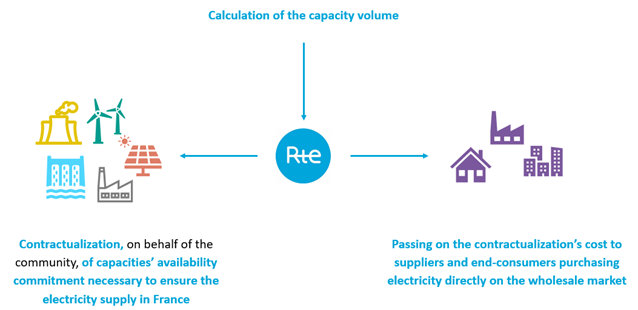
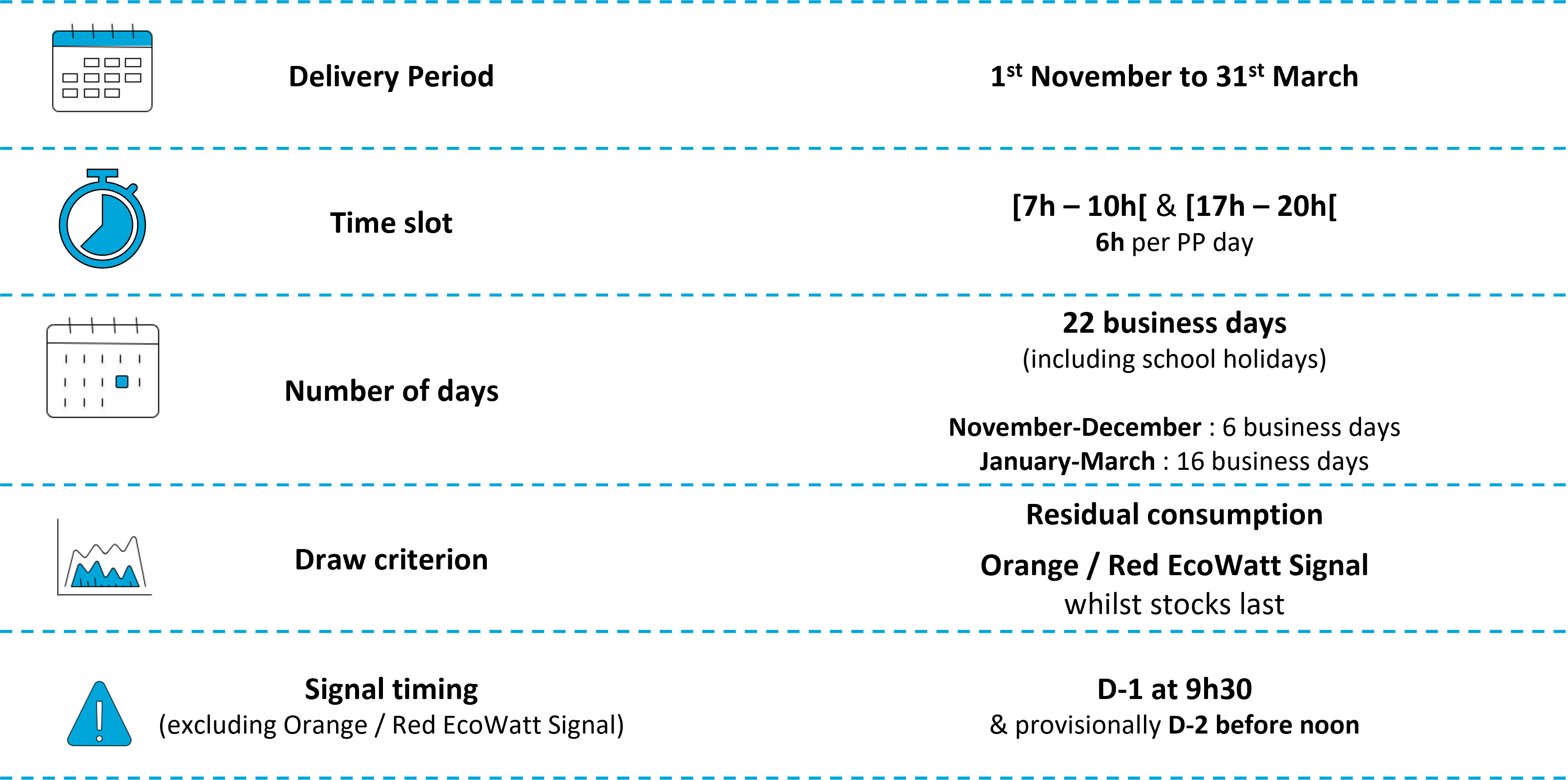
- RTE contracts the capacity volume (in MW) necessary to ensure the electricity supply in France for each delivery period (PL). This delivery period covers an electric winter that extends over two calendar years (November to March).
- This contractualization takes place after auctions to select the required capacities at the best price for the community. There are two auctions when the new capacity mechanism is fully operational: the first in the years preceding the delivery period and the second in the months preceding the delivery period. For the capacities selected in the auctions, the capacity operators contractually commit to the availability of these capacities during peak period of the delivery period in return for a payment by RTE (this payment is made after verification of the capacities’ availability during the delivery period). Availability commitments may be exchanged between capacity operators on a secondary market.
- The contractualization’s cost of the capacity volume is passed on to suppliers (and end-consumers purchasing electricity directly on the wholesale market or system operators for their losses) by means of a tax levied by RTE. The amount of this tax is proportional to the consumption of each supplier (or end-consumer purchasing electricity directly on the wholesale market or system operators for their losses) during peak period of the delivery period.
The implementation of existing AOLT contracts are adapted to the new capacity mechanism. A new multi-year capacity contracting mechanism covering several delivery periods is introduced in the new mechanism for new capacity projects.
A single PP signal is implemented to monitor availability commitment and calculate the tax during times of system stress within each delivery period.
A note (in French) explaining the selection method of Peak Period (PP) days is available in the Pedagogical documents section.
Participants of the new capacity mechanism
The new capacity mechanism involves capacity operators, contributors and system operators.
The Certification perimeter holder (TPC) is accountable to RTE for the availability commitments on its perimeter. The TPC either operates the sites on its perimeter or has a delegation from third-party operators to operate their sites on the capacity mechanism.
In order to participate in the new capacity mechanism, the TPC must sign a Participation agreement (AP) with RTE, which is valid for the entire duration of the new capacity mechanism.
If you wish to become TPC in the new capacity mechanism, RTE provides you with the Formulaire de demande de conclusion d’un accord de participation au mécanisme de capacité en qualité de titulaire de périmètre de certification (cf. the Contractual documents section). We encourage you to return this form duly completed and signed with all the mandatory documents to the following email address: rte-mecanismecapacite@rte-france.com. Thanks to these elements we will be able to generate your AP and send it back to you for signature.
Contributors are subject to a tax calculated on the consumption of their customer portfolio (for suppliers or producers entering a direct electricity sales contract) or on their own direct consumption (for end consumers purchasing electricity directly on the wholesale market or for system operators for their losses) during the peak period of the delivery period.
Each system operator is responsible to certify the capacities on its service area (RTE for the capacities connected to the public transmission network and the foreign capacities, the DSOs for the capacities, connected to the public distribution network) during the certification period.
The operational actions taken by DSOs for capacity certification are carried out via the GIPSE portal. DSOs who already have access to GIPSE can perform these actions directly without taking any further action. As with the other market mechanisms managed by RTE, it is possible to set up a mandate for another DSO to perform these actions on your behalf.
Reminder: the mandate is unique for the management of all market mechanisms operated via GIPSE. Therefore, it is not possible for a DSO to appoint multiple mandatories.
Target planning

Once the new capacity mechanism is fully operational, 2 auctions are held before each delivery period (PL).
- Auction 1 is the main auction. Its purpose is to compare all the bids to contract most of the capacity volume required to ensure the electricity supply.
- Auction 2 is the balancing auction. Its purpose is to increase demand if necessary (in the event of an anticipated deterioration in security of supply). This auction also offers a dedicated volume for decarbonised flexibilities that cannot participate in auction 1, 4 years before the delivery period.
Any capacity wishing to participate in an auction must be certified prior to the auction. Applications for certification must be submitted by the TPC during the certification gate!
Transitional planning
At the beginning of the new capacity mechanism, it will not be possible to run auctions 4 years before the delivery period. Therefore, adaptations are being made to the nominal auction system: 2026-2027 / 2027-2028 / 2028-2029 / 2029-2030 PLs, a single auction system is introduced.
This single auction combines the characteristics of auctions 1 and 2 (as described above): all the bids are compared to contract the entire capacity volume required to ensure the electricity supply, while ensuring a dedicated volume for decarbonised flexibility.
Find out more
The webpage New Capacity Mechanism - Parameters and market parties contains the three following tabs:
- Certification perimeter holders (TPC) : list of all the TPC having signed an Accord de Participation with RTE;
- Parameters of the new capacity mechanism: certification parameters, economic parameters, important dates for each delivery period;
- Financial settlements.
The webpage New capacity Mechanism - Auctions and secondary market contains the two following tabs:
- Auction result
- Auction report and secondary market summary
After several years of consultation with market stakeholders, a new capacity mechanism was established by Law No. 2025-127 of 14 February 2025 on finance for 2025 and was authorised by the European Commission on 22 December 2025.
- Articles L.316-1 à L.316-13 du code de l’énergie
- Articles R316-1 à R316-42 du code de l'énergie
- Articles L.322-5 à L.322-21 du code des impositions sur les biens et services : taxe de répartition des coûts du mécanisme de capacité
- Approbation de la Commission européenne en date du 22 décembre 2025
TPCs are authorised not to declare a remuneration cap for their Certification Entities (EDC) when submitting their certification application in the following cases only:
- The EDC is a Consumption EDC located in mainland France;
- The EDC is a pluriannual EDC;
- Each site attached to the EDC are exempt under Article R. 316-24 of the "Code de l'Energie" and the TPC provided the corresponding formulaire d’exemption;
- The TPC is able to provide the PPI exemption certificate issued by the CRE for each site attached to the EDC. Sites that do not benefit from one of these two exemptions may not be attached to the EDC.
Information on the process for obtaining this exemption can be found on the CRE website.
Contractual documents (in French)
- Formulaire de demande de conclusion d’un accord de participation au mécanisme de capacité en qualité de titulaire de périmètre de certification
- Déclaration de la qualité de TPC en tant qu'exploitant ou acheteur obligé des sites
- Mandat de délégation de l’exploitant au TPC pour la certification de sites d’injection ou de stockage
- Mandat de délégation de l’exploitant au TPC pour la certification de sites de soutirage
- Déclaration sur l'honneur pour les sites de soutirage disposant d'une puissance souscrite inférieure ou égale à 36kVA ou pour les sites de soutirage disposant d’une puissance souscrite inférieure ou égale à 250 kW rattachés à une EDC de plus de 1000 sites
- Formulaire d’identification d’un groupe de calendrier fournisseur à période mobile
- Modèle d’engagement de respect des limites d’émissions de CO2 des EDC certifiées au titre du Mécanisme de Capacité pour les Sites raccordés au RPD
- Formulaire de déclaration d’exemption – Prix Plafond Intermédiaire
- Formulaire de préqualification d'un site au pluriannuel
- Mandat de délégation de l'exploitant d'un site d'injection ou de stockage pour le processus de préqualification au pluriannuel
- Fiche d'éligibilité au pluriannuel
- Description et calendrier du projet pluriannuel
- Formulaire d’identification des Contributeurs
- Formulaire de déclaration du périmètre d’un Contributeur
- Accord de rattachement d’un consommateur au périmètre d’un Contributeur
- Accord de retrait d’un consommateur au périmètre d’un Contributeur
- Accord de rattachement d’un Acheteur de Pertes à un périmètre de Contributeur
Pedagogical documents (in French)
- Information sheets TPC (last updated 04/09/2026)
- Information sheets Contributor (last updated 31/07/2026)
- Information sheets Vdispo (last updated 16/10/2026)
- Frequently asked questions (last updated 31/07/2026)
- Selection method of Peak Period (PP) days
These information sheets are explanatory documents intended for informational purposes; the mechanism rules take precedence.
Access the Information System
In order to access RTE’s market applications, you need a PKI digital certificate. The page Access the RTE Information System - RTE Services Portal explains how to request a PKI digital certificate.
- Link to RMC – to upload a file
- Link to RMC – to consult data sent to RTE
- Link to RMC – to receive data sent by RTE
- Technical guide RMC (update 22/09/2026)
For EDC RPT, all supporting documents (mandates and PPI exemptions) must be sent to rte-mecanismecapacite@rte-france.com.
You can access all of RTE’s market applications from the page Accessing market applications - RTE Services Portal.
Contact
Your sales representative is at your disposal for any additional information on the capacity mechanism.
If you have any questions, you are welcome to reach out to RTE via email:
- For all matters relating to the ongoing operational activities: rte-mecanismecapacite@rte-france.com.
- For more general questions about the functioning of the mechanism, its rules and the concertation: rte-nouveaumecapa-reglementaire@rte-france.com.
Additional information
The operational functioning of the previous capacity mechanism in force from the 2017 to the 2026 AL keeps being ensured until the final obligation and NCE for the AL 2025 and 2026 are calculated in 2028. More informations here: Capacity Mechanism - AL 2017-2026.